
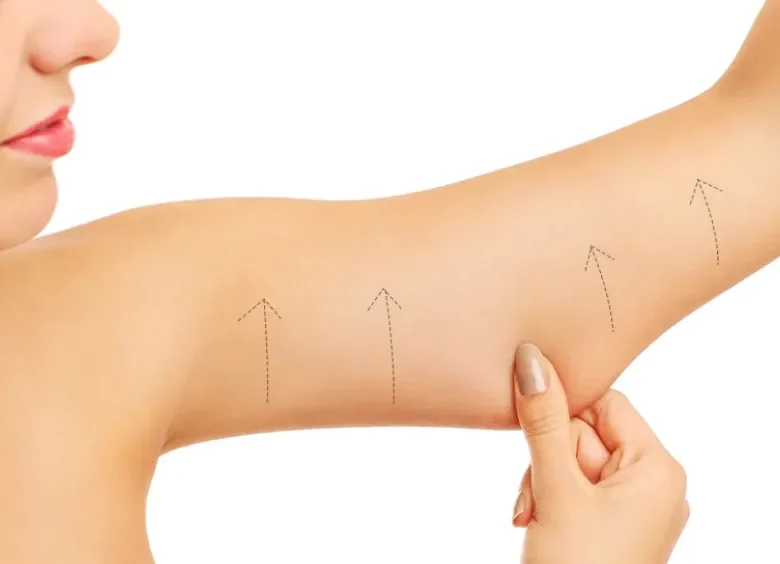
You’ve lost 80 pounds. You’ve finished breastfeeding two kids. You’re in your late 40s and the skin on your upper arms now swings when you wave. You’ve tried every cream, every laser, every “skin tightening” device sold on Instagram. And the loose skin is still there.
That’s not a failure of will. That’s physics. Skin has a finite elastic limit. Once the collagen and elastin fibers are stretched past a certain point—or degraded by age and sun—they do not bounce back on their own. No amount of lotion will re-spool those fibers.
This article is not medical advice. Consult a board-certified plastic surgeon before making any decisions. What follows are five specific, measurable signs that surgery is worth a serious conversation. And for each sign, we’ll tell you exactly which procedure matches the problem.
Sign #1: The “Pinch Test” Exceeds 2 Inches
This is the single most objective measure. Stand in front of a mirror. Pinch the loose skin on your abdomen, upper arms, or inner thighs between your thumb and forefinger. Measure the thickness of that fold with a ruler.
If the pinch is 2 inches or more, non-surgical treatments will not fix it. Here’s why.
Radiofrequency devices (like Morpheus8 or Thermage) and ultrasound (Ultherapy) work by heating the dermis to stimulate new collagen. They produce mild tightening—maybe 10-20% improvement in mild cases. But they cannot remove excess skin. They cannot shorten the skin envelope. They simply thicken what’s there.
When the pinch is over 2 inches, the problem is not just laxity. It’s redundant skin volume. The only way to remove that volume is to cut it out.
What the research says
A 2026 review in Aesthetic Surgery Journal examined 1,200 patients who had undergone abdominoplasty (tummy tuck). The average skin resection weight was 2.4 pounds. The average pinch thickness before surgery was 2.8 inches. Patients with less than 1.5 inches of pinch were not considered surgical candidates.
That’s a useful benchmark. If your pinch is under 1.5 inches, you’re in the range where non-surgical options might work. Above that? You’re wasting money on lasers.
Which procedure matches this sign
For the abdomen: abdominoplasty (full tummy tuck) or panniculectomy if the skin hangs down over the pubic area. For arms: brachioplasty (arm lift). For thighs: thigh lift.
These are major surgeries. Recovery takes 4-6 weeks. Scars are permanent. But the result is permanent too—the skin is gone and will not come back.
Sign #2: Skin Folds Cause Chronic Rashes or Infections
This is the one sign that moves loose skin from a cosmetic issue to a medical one. When skin hangs in folds, it traps moisture, heat, and bacteria. The result is intertrigo—a red, raw, itchy rash that can progress to a bacterial or fungal infection.
If you’re treating the same rash under your belly flap or inner thighs every month with antifungal creams, you’re treating the symptom, not the cause.
Insurance companies in most states will cover panniculectomy if the skin overhang causes documented, recurrent infections. You need proof: photos, doctor’s notes, prescription records. Medicare and many private insurers follow the same criteria: at least three documented episodes of intertrigo in 12 months, with failed medical management.
This is not cosmetic surgery at that point. It’s reconstructive. And the threshold for considering it is lower than you think.
When surgery becomes medically necessary
In California, for example, the California Medical Association’s guidelines state that panniculectomy is medically necessary when the pannus (the hanging skin) causes chronic maceration, ulceration, or infection that does not respond to conservative treatment. Similar standards apply in Texas, New York, and Florida.
If you have this problem, you don’t need to “consider” surgery. You need to see a surgeon who takes insurance.
Sign #3: Your Skin Does Not Move When You Exercise
Here’s a test. Lie on your back. Do a crunch. Watch your abdominal skin.
If the skin stays in a heap on your ribcage while your muscles contract underneath, that’s skin-muscle dissociation. The skin is no longer attached to the underlying fascia. It’s like a loose bedsheet on a mattress that’s been stripped.
This is common after massive weight loss (100+ pounds) and after multiple pregnancies. The connective tissue that anchors skin to muscle has been permanently stretched or torn.
No exercise will fix this. No cream will re-anchor the skin. The only solution is a surgical lift that re-drapes the skin over the muscle and sutures it back into place.
The numbers behind it
A 2026 study in Plastic and Reconstructive Surgery followed 340 post-bariatric patients. Those with more than 3 cm (about 1.2 inches) of skin-muscle separation on CT scan all reported that exercise made the skin sag worse. Gravity pulls the loose skin downward during movement, creating a pendulum effect that actually stretches the skin further.
If you feel like your skin is working against you in the gym—flapping, chafing, pulling—that’s not in your head. It’s a structural problem with a structural solution.
Which procedure matches this sign
Abdominoplasty with rectus diastasis repair is the standard. The surgeon tightens the abdominal muscles (which are often separated after pregnancy or weight loss) and removes the excess skin in one operation. For arms and thighs, the same principle applies: a brachioplasty or thigh lift reattaches the skin to the underlying fascia.
Sign #4: You Have “Bat Wings” That Do Not Respond to Strength Training
Upper arm skin laxity is the most common complaint among women over 40. And it’s the most resistant to non-surgical treatment.
Here’s why. The upper arm has very little subcutaneous fat. When skin loses elasticity, there’s no fat to “fill” the loose envelope. It just hangs. Triceps exercises build muscle, but the muscle sits underneath the skin. If the skin envelope is too large, bigger muscles just stretch it further.
If you can grab a handful of skin on the back of your arm that is more than 1.5 inches thick, and you’ve been doing triceps dips for six months with no visible change, you are done with exercise as a solution.
What works and what doesn’t
Non-surgical options for arms are particularly weak. Morpheus8 can produce mild improvement in skin texture, but studies show an average reduction of only 0.3 inches in arm circumference after three sessions. That’s barely visible. A brachioplasty removes 2-4 inches of circumference in one operation.
The tradeoff is the scar. A brachioplasty scar runs from the armpit to the elbow along the inner arm. It fades over 12-18 months but never disappears entirely. For many women, that trade is worth it. For others, it’s not.
Our recommendation: If you can’t wear sleeveless tops without feeling self-conscious, and you’ve tried everything else, brachioplasty is the only permanent fix. The scar is a straight line. The loose skin is a volume you can grab. Pick your trade.
Sign #5: The Loose Skin Is Affecting Your Mental Health
This is the hardest sign to measure and the most important one. Studies consistently show that body contouring surgery after weight loss improves quality of life more than the weight loss itself did.
A 2026 study from the University of Michigan surveyed 200 patients who had undergone body contouring after bariatric surgery. The patients reported a 40% improvement in body image scores and a 30% reduction in social avoidance behaviors. They were more likely to exercise in public, wear fitted clothing, and initiate romantic relationships.
That’s not vanity. That’s function. When loose skin prevents you from living normally—avoiding the gym, skipping beach vacations, wearing only oversized clothing—it has crossed the line from cosmetic to quality-of-life.
The question to ask yourself: “If I could wave a wand and remove this skin, would I change how I live my life?” If the answer is yes, and you’ve been saying yes for more than a year, you have your answer.
When NOT to consider surgery
Surgery is not the answer if:
- You are still actively losing weight. Wait until your weight has been stable for at least 6 months.
- You smoke. Smoking dramatically increases complication rates. Most surgeons require 4-6 weeks of nicotine-free status before operating.
- You have uncontrolled diabetes or a BMI over 35. Surgical risks rise steeply above these thresholds.
- You are hoping for a “perfect” result with no scars. Every lift leaves scars. The goal is improvement, not perfection.
Quick Reference: Procedure vs. Problem
| Problem Area | Pinch Thickness | Recommended Procedure | Recovery Time | Scar Location |
|---|---|---|---|---|
| Abdomen | > 2 inches | Abdominoplasty / Panniculectomy | 4-6 weeks | Low horizontal, hip to hip |
| Upper arms | > 1.5 inches | Brachioplasty | 2-4 weeks | Inner arm, armpit to elbow |
| Inner thighs | > 2 inches | Thigh lift | 4-6 weeks | Inner groin, extending down thigh |
| Lower face / neck | > 1 inch (jowl pinch) | Facelift / Neck lift | 2-3 weeks | Around ear, into hairline |
Final word: Loose skin is not a character flaw. It’s a physical condition with physical solutions. If you have two or more of the signs above, book a consultation with a board-certified plastic surgeon. Not a med spa. Not a dermatologist who “also does” lasers. A surgeon who performs these procedures regularly. Ask to see before-and-after photos of patients with your body type. Ask about complication rates. And ask yourself honestly: has the loose skin taken enough from you already?